 Share This


Auto-Translate
Summary
Plants need more than light—they need real darkness too. Some species, like cannabis, already react to light levels just above full moon levels. Even tiny light leaks at night (LED indicators, streetlights, or gaps) can confuse their biological clock, delay flowering, and cut yields. Measure darkness during your plants’ dark period and keep light levels low to prevent negative effects. Traditional PAR meters can’t detect such low levels, however with the Photone app you can! Thanks to its excellent measurement sensitivity, detecting light levels down to 0.00001 μmol/m²/s it turns invisible light pollution into something you can fix.
What Is Light Pollution?
Light pollution refers to any unwanted or excessive light during a plant’s intended dark period, also called Artificial Light at Night (ALAN). Just as humans rely on darkness in their circadian rhythm to regulate healthy sleep, plants depend on uninterrupted darkness in light-dark cycles to regulate growth and flowering signals.
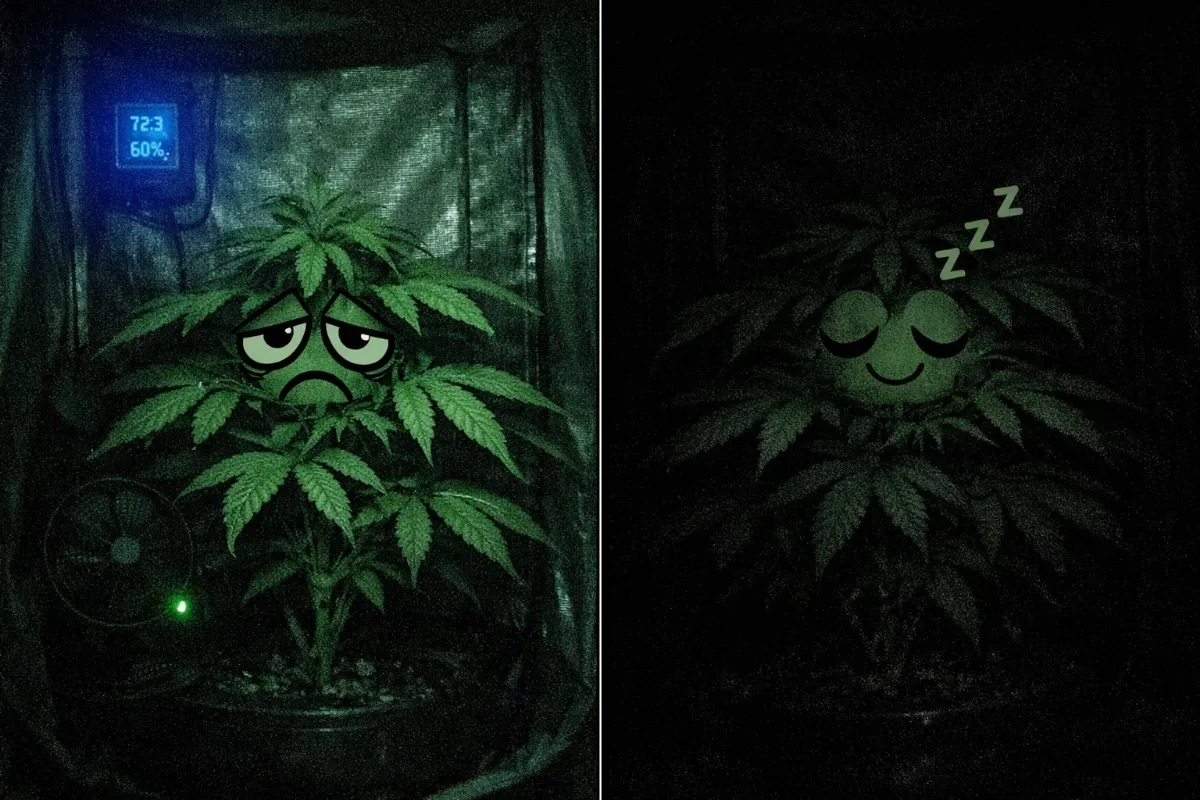
In grow rooms and tents, light pollution often comes from small but persistent sources such as indicator LEDs, control displays, hallway light leaking in, or poorly sealed zippers and ventilation openings. Plants grown outdoors or near windows can also be affected by artificial light from streetlights, neighboring greenhouses, or other lights that remain on during nighttime.
How Light Pollution Disrupts Plant Growth Cycles
Plants exposed to light during their dark phase experience physiological stress, weakening their immune response and making them more vulnerable to disease. For photoperiod-sensitive species like cannabis, light pollution can have various negative effects [1] such as:
- Delayed flowering
- Increased energy and water consumption
- In extreme cases even return to their vegetative stage
- Hermaphroditism (Some growers report that light stress can cause plants to develop both male and female traits, which can reduce cannabinoid content and production of seeds, though this effect is not yet scientifically researched)
How Do Plants Separate Between Night and Day?
For a plant, night is not defined by the absence of photosynthesis, but by the absence of detectable light. Even very faint illumination can signal that “night is over,” which is why small light leaks can disrupt their internal timing. This sensitivity exists because plants use light in two fundamentally different ways:
1) Light as energy
Photosynthesis requires relatively high light intensities and typically occurs at PPFD levels above 10 μmol/m²/s. This is the light that drives growth and biomass production.
2) Light as information
Plants also use specialized photoreceptors—such as phytochrome—to sense light as a signal. These receptors regulate biological timing, telling the plant when to start or stop processes like flowering—this can already happen at very low light levels below 1 μmol/m²/s. [2]
Darkness Requirements for Plants
Plants don’t experience darkness as a simple on/off switch. What matters is how long the dark period lasts and how much light is present during it.
Duration of the dark period
In general, plants should experience a continuous dark period roughly the same length of a natural night. As a practical baseline, providing at least 6–8 hours of uninterrupted darkness supports healthy biological rhythms for many plants, though the exact requirement varies depending on species and growth stage.
Light intensity during the dark period
Darkness is not only about duration—it also means keeping light levels extremely low throughout that time. The acceptable intensity thresholds also vary by species. As a natural reference, full moonlight shows PPFD levels of roughly 0.002 μmol/m²/s, which is already close to the threshold where particularly sensitive plants begin to react.
Growing sensitive plants like cannabis (except from autoflowering species) require long, uninterrupted dark periods with extremely low light levels to reliably initiate and maintain flowering. Research shows that cannabis can respond negatively to light intensities above ~0.01 µmol/m²/s. [3]
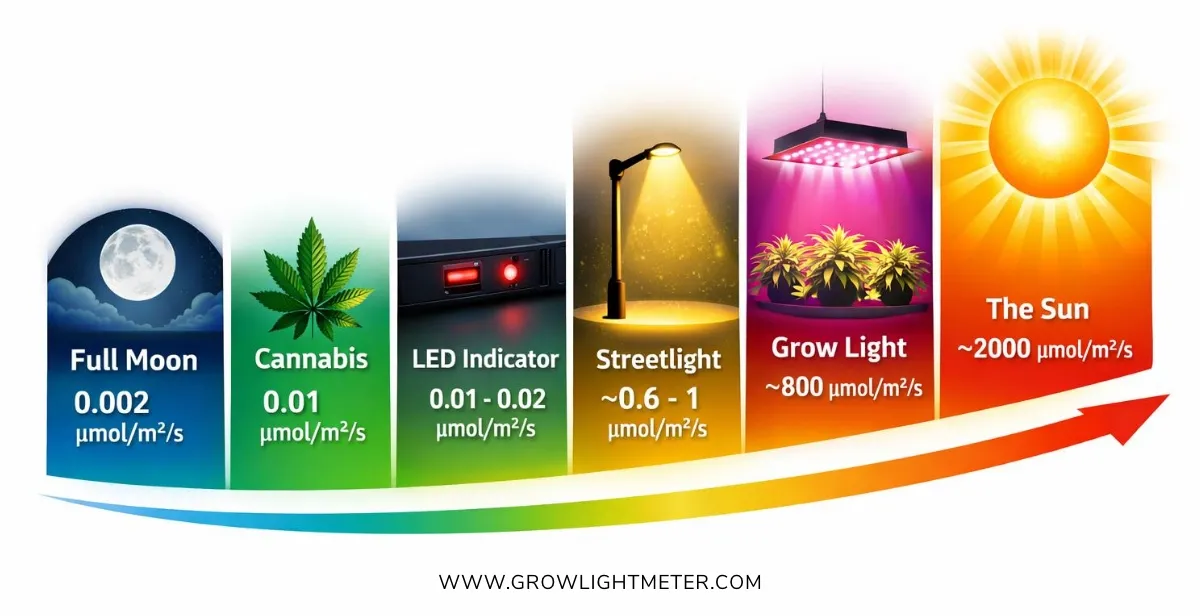
Most common houseplants are less sensitive but they still require several hours in darkness each day to flourish. Exact thresholds are not established for every species but it can still be worth researching for published values online. Otherwise using values from closely related species is often the most practical approach. For example, poinsettias can be disturbed by nighttime light brighter than 0.1 μmol/m2/s and succulent plants like Kalanchoe need to be kept under 0.43 μmol/m2/s at night. [4]
Outdoor crops can also be affected at surprisingly low levels. Studies on soybeans show negative responses to nighttime illumination only slightly above full moonlight, demonstrating that even extremely low lighting can interfere with natural growth cycles. [4]
If you’re unsure how much light your plant can handle during its dark period, aim for less than 0.002 μmol/m²/s—this matches the natural darkness of a full-moon night, ensuring conditions close to what your plant would experience in their natural environment.
How to Detect Light Pollution
Don’t leave your plants’ well-deserved sleep to guesswork. Now that you understand their requirements, it’s time to measure the darkness they actually get.
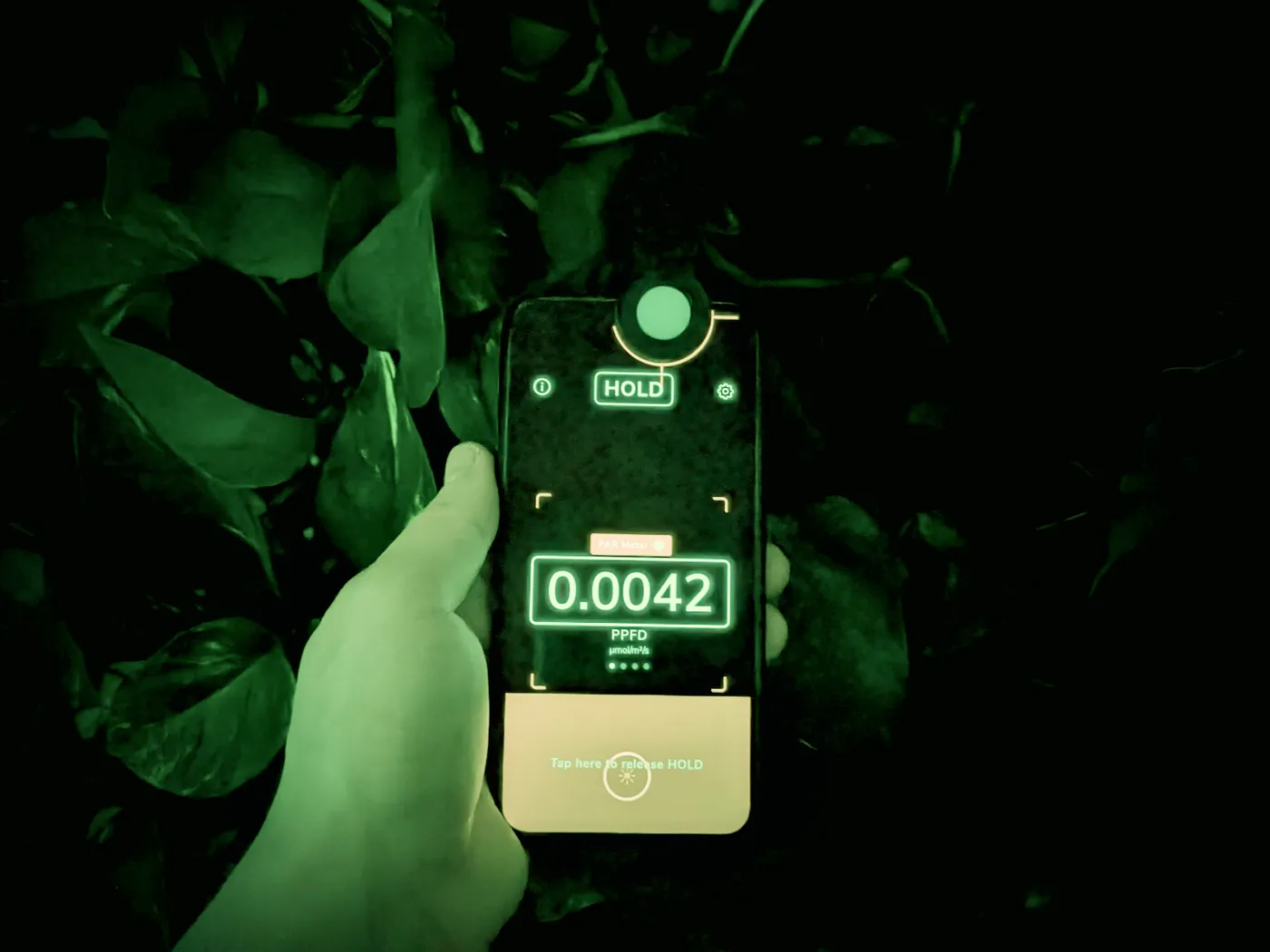
Download the Photone app for free and turn your phone into an accurate light meter for low-light measurement. Photone can measure darkness just as effectively as bright grow lights, thanks to fully leveraging the smartphone’s camera sensor using RAW image processing.
With a sensitivity down to 0.00001 μmol/m²/s, Photone can reliably assess the darkness requirements of any plant. Its automatic low-light mode activates in near-dark conditions, making otherwise invisible light pollution measurable and actionable for growers.
Why Traditional PAR Meters Fail at Low Light Levels
Most PAR meters are built for measuring high-intensity photosynthetic light, making them ill-suited for detecting the subtle light levels present at night. Even premium sensors, like the MQ-500 by Apogee Instruments, only resolve down to 0.04 μmol/m²/s which is 40 times less sensitive than what’s needed to accurately assess light pollution.
To address this gap, manufacturers offer specialized (and expensive) light pollution sensors, such as Apogee’s SQ-640-SS. But here’s the question: Why invest over $1,000 in two separate devices when a single app on your phone can do the job—and more? Check out the Photone app if you haven’t done so already.
How to Protect Your Plants’ Dark Period
First of all you should measure at different spots to identify sources of light pollution. These strategies may then help you to mitigate light pollution, depending on where you grow your plants:
Inside Greenhouses or Grow Boxes
- Seal Gaps and Seams: Check zippers, vents, window frames, and cracks for light intrusion.
- Cover Persistent Sources: Use tape to block LEDs on controllers, timers, fans, or sensors.
- Use Reliable Timers: Opt for high-quality timers to maintain precise light cycles.
- Inspect Grow Lights: Some LEDs emit faint light even when off. Turn them off, let your eyes adjust, and check for residual glow. Mechanical timers that fully cut power can eliminate this issue.
Inside Your Home
- Move plants away from street-facing windows or bright hallways.
- Install blackout curtains or reflective window films.
- Turn off indoor lights at night and cover small LEDs near your plants.
Outdoor or Crop Growers
- Position plants to minimize exposure to streetlights or building lights.
- Use light barriers like solid fences or covers to block external light.
- Limit your own outdoor lighting with timers or motion sensors.
- Coordinate with neighbors to reduce unnecessary nighttime illumination.
After making adjustments, use the Photone app to measure light levels again and ensure they’re below the safe threshold. Repeat measurements occasionally—regular checks help catch issues early and keep your plants thriving.
Give your plants the light they need and the uninterrupted darkness they deserve!
Sources
[1] Grognuz, Vincent, Katja Gisler, and Eva Knop. “Artificial Light at Night (ALAN) Disrupts Timing of Floral Resource Availability.” Biological Conservation 314 (2026): 111650. https://doi.org/10.1016/j.biocon.2025.111650.
[2] Czechowicz, Katarzyna. “Light Pollution Poses Huge Problems for Plants.” Science In Poland, 2025. https://scienceinpoland.pl/en/news/news,107569,light-pollution-poses-huge-problems-plants.html.
[3] Eckels, Madigan, and Bruce Bugbee. “Revisiting Light Pollution Effects on Photoperiodic Growth in Short-Day Plants: Photon Quantity and Quality Thresholds for Sensitive Species.” Environmental and Experimental Botany 237 (2025): 106203. https://doi.org/10.1016/j.envexpbot.2025.106203.
[4] Vince-Prue, D. Photoperiodism in Plants. New York: McGraw-Hill, 1975, 80–83. ISBN 9780070840485.