 Share This


Auto-Translate
Modern horticultural lighting increasingly relies on targeted wavelengths to fine-tune plant growth. One common addition to full-spectrum fixtures are supplemental deep red (660 nm) LED booster lights. Read along to learn what they are, why they are used, and how to measure them correctly.
What Are Deep Red LED Boosters?
Deep red LED boosters are dedicated light sources emitting primarily around 660 nm, a wavelength that aligns closely with one of the main absorption peaks of chlorophyll, the main driver of photosynthesis. These boosters are often added as separate bars or modules alongside a primary white or full-spectrum LED fixture. Their purpose is not to replace the main light, but to selectively enhance the red portion of the spectrum.
Effects of Supplemental Deep Red 660 nm Lighting
Why do growers use additional 660 nm deep red lighting? The main reason is because of its strong influence on photosynthesis and plant morphology. The positive effects can be summarized as follows:
- Increased photosynthetic efficiency, as 660 nm light is highly effective at driving carbon fixation
- Improved flowering and fruiting responses
- Enhanced canopy penetration, since red light is less scattered than shorter wavelengths
- Spectral balancing, allowing growers to compensate for white LEDs that may be relatively weak in deep red output
Used correctly, deep red boosters can improve yield quality and consistency without dramatically increasing overall power consumption.
For cannabis cultivators specifically, deep red supplementation during flowering promises denser bud development, faster finish times, and enhanced cannabinoid production – all while remaining highly energy-efficient.
However, current research doesn’t differentiate recommended PPFD or DLI levels with or without deep red lighting – supplementing deep red will just get you up to these levels more energy efficiently.
Far Red (>700 nm) vs. Deep Red (≈660 nm): What’s the Difference?
Although often grouped together in conversation, deep red and far red light have very different roles:
Far red (>700 nm) has little direct photosynthetic contribution but strongly affects plant signaling via the phytochrome system. It influences processes such as shade avoidance, stem elongation, and flowering timing.
Deep red (≈660 nm) directly drives photosynthesis and contributes measurable PPFD.
Because of this, deep red is typically counted fully toward PPFD when measuring PAR, while far red is treated separately and only included in ePAR.
How to Measure Deep Red LEDs With Photone
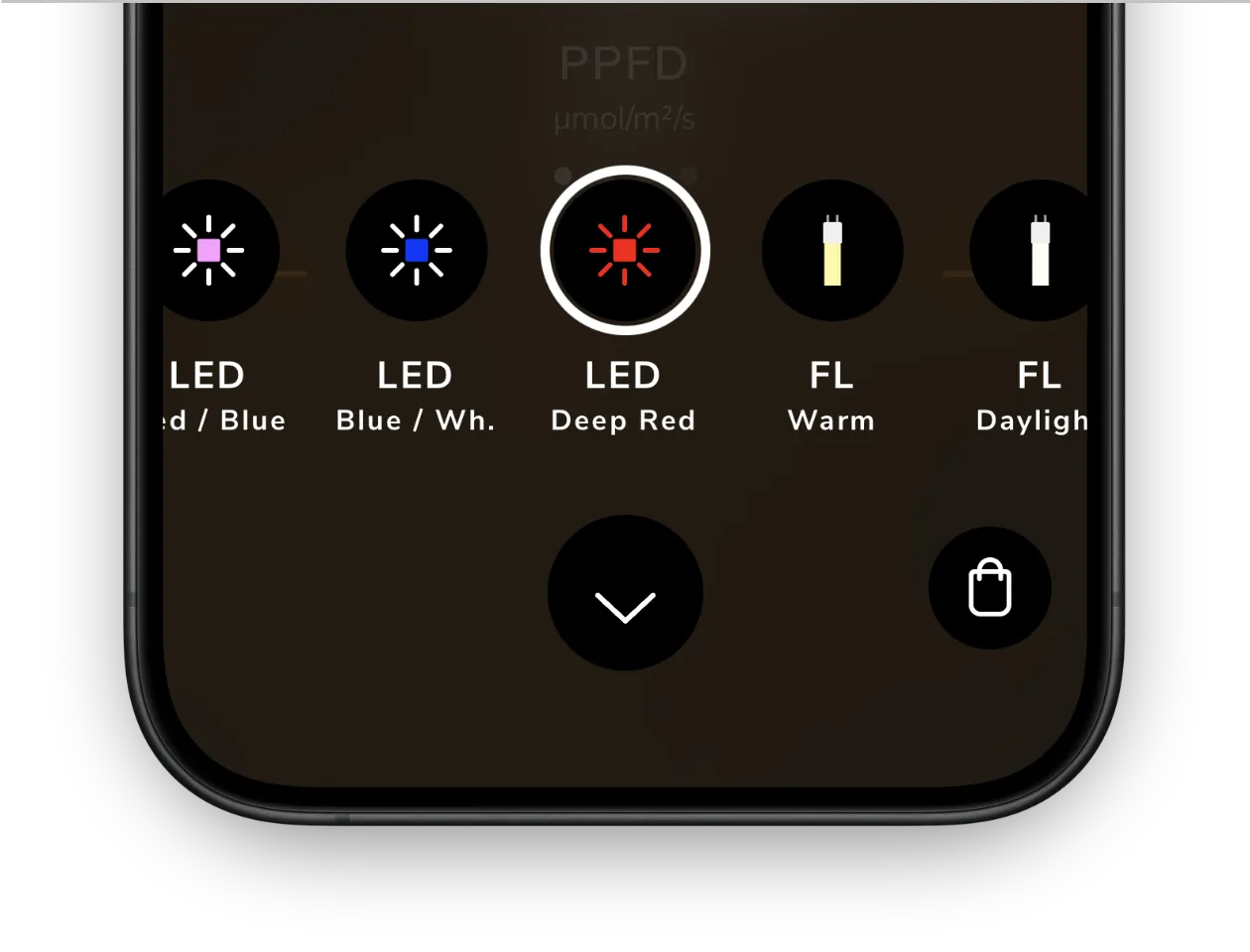
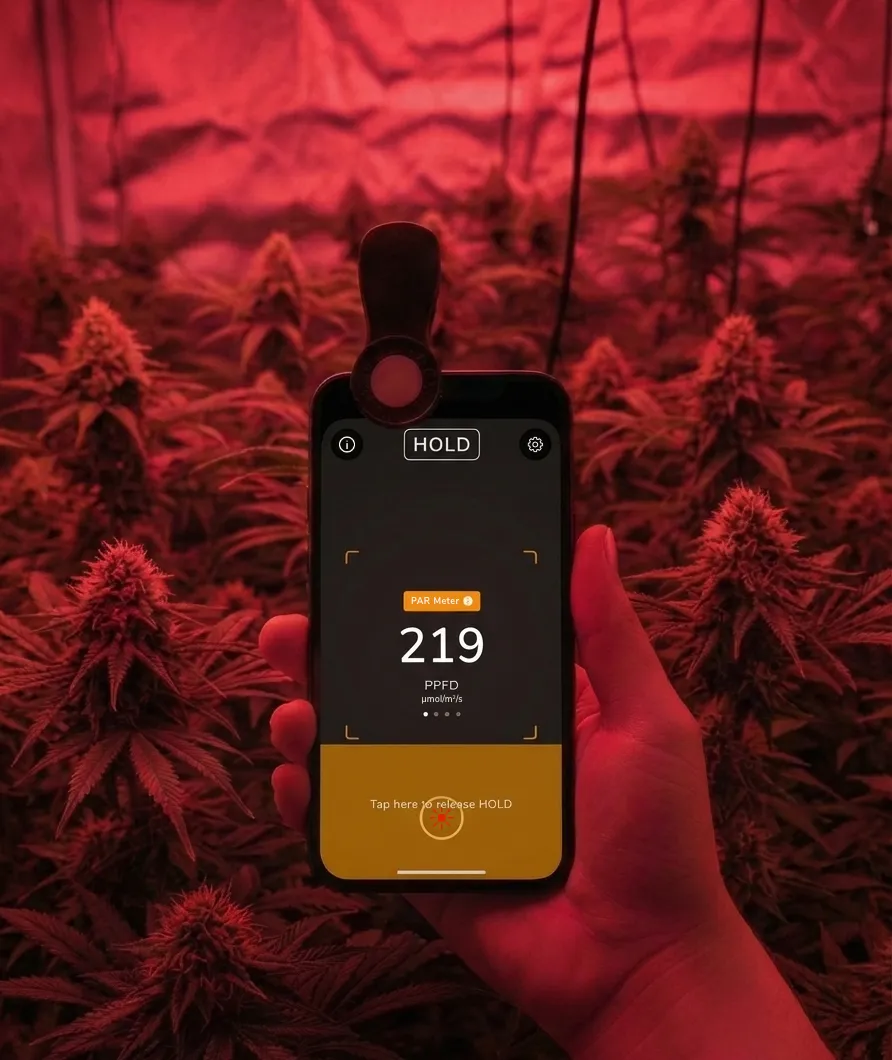
If your mainly white LED fixture just contains additional red LEDs you can simply select the “LED Full Spectrum + Red” light source setting and you're good to go.
However, if you have supplemental 660nm LED boosters such as these, you should use the “LED Deep Red” setting to measure just the booster. Then sum up the measurement of the boosters with the measurement of your main grow light (without the boosters) to get the total PPFD or DLI your plants receive.