Auto-Translate
Ask ten growers how much light their plants need and you'll get ten answers in ten different units: watts, lumens, lux, PPFD, "two feet from the canopy." Only one number actually answers the question, and that's the daily light integral.
DLI is the total amount of usable light your plants receive over 24 hours. It's the single most useful figure in plant lighting, because it's the one your plants actually respond to. Here's what it is, how to work it out, and what to aim for.
Key Takeaways
- DLI = light intensity × time. It combines PPFD with your photoperiod into one daily total, measured in mol/m²/d.
- The formula is simple:
DLI = PPFD × hours × 0.0036 - Intensity alone tells you very little. A dim lamp running long can deliver the same DLI as a bright lamp running short.
- More is not always better. Every plant has a saturation point, above which extra light is wasted energy at best and damage at worst.
- You don't need a dedicated meter. Photone measures PPFD and calculates DLI on the phone you already own.
What Is the Daily Light Integral?
The daily light integral combines light intensity with lighting duration over a 24-hour window. It's measured in mol/m²/d — moles of photons per square meter per day.
Think of it as rainfall. Knowing it's raining doesn't tell you whether your garden got watered; you need to know how hard and for how long. Light works the same way. Intensity is the rate, DLI is the total that lands in the bucket by the end of the day.
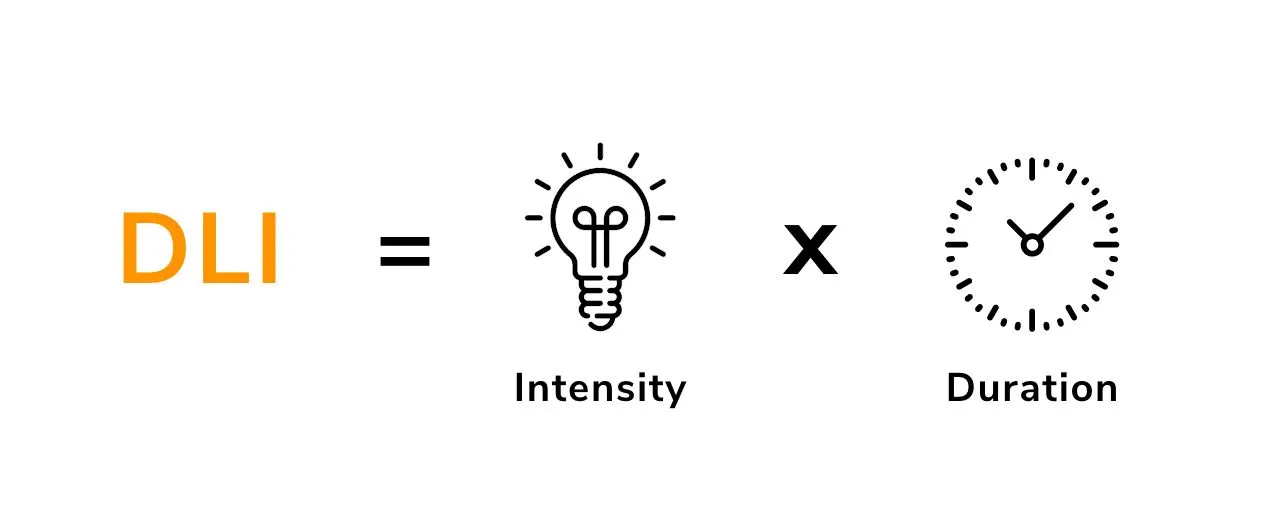
The intensity half of that equation is PPFD (photosynthetic photon flux density), measured in µmol/m²/s. It counts the photons between 400 and 700 nm — the range plants use for photosynthesis — arriving at a given spot each second. This is not the same as brightness as your eye perceives it, which is why lux readings and wattage figures are so misleading for plants. (We cover that in detail in PAR/PPFD vs. Lux and Grow Light Metrics Explained.)
DLI simply extends that per-second measurement across a full day.
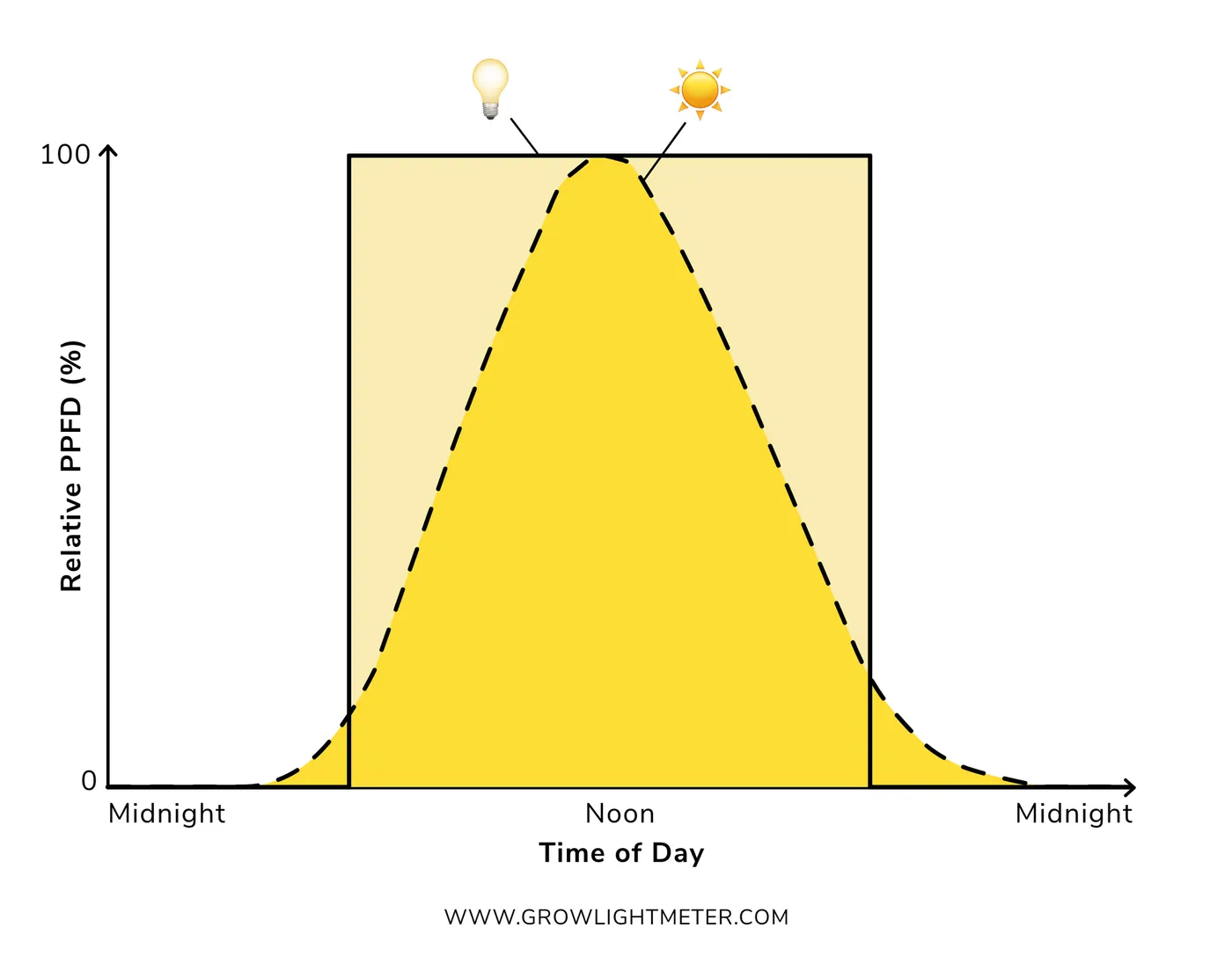
Outdoors, DLI swings with season, latitude, weather, and shade. A clear midsummer day at mid-latitudes can deliver 40–60 mol/m²/d, while an overcast day in December might scrape past 2. Under glass, expect to lose 30–50% of that to the greenhouse structure. Indoors under artificial light, the picture is much simpler: your lamp puts out the same intensity every second it's on, so the daily total is entirely under your control.
How to Calculate DLI
There are two ways to arrive at a DLI figure, and which one you use depends on whether the sun is involved.
1. Projected DLI (instant)
Measure PPFD once at canopy level, then multiply by your photoperiod:
Example: a lamp delivering 500 µmol/m²/s for 12 hours gives 500 × 12 × 0.0036 = 21.6 mol/m²/d.
This takes seconds and works with any PAR meter. It's accurate for artificial lighting on a fixed schedule, because the assumption behind it — constant output for the whole photoperiod — is actually true. It falls apart the moment sunlight enters the picture.
2. Actual DLI (24-hour measurement)
Log PPFD continuously over a full day and add up every reading. This captures the real curve: sunrise, sunset, passing clouds, and any seasonal drift.
It's the only honest method for outdoor grows, greenhouses, windowsills, and any setup that mixes daylight with supplemental lighting. The cost is that you need a logging sensor and you have to wait a full day for your answer.
Why DLI Beats PPFD as a Target
This is the part most growers miss: intensity on its own tells you almost nothing.
Consider two rooms:
| PPFD | Photoperiod | DLI | |
|---|---|---|---|
| Room A | 900 µmol/m²/s | 12 h | 38.9 mol/m²/d |
| Room B | 600 µmol/m²/s | 18 h | 38.9 mol/m²/d |
Identical daily light, delivered two completely different ways. Room B does it with a smaller, cheaper, cooler-running fixture. Room A needs a powerful lamp and probably active cooling to go with it.
That's the practical value of thinking in DLI: it turns lighting into a budget you can spend however suits your space, your electricity tariff, and your heat load — rather than a single intensity number you chase blindly.
Too Little, Too Much, and the Sweet Spot
Plants respond to increasing light along a curve, not a straight line.
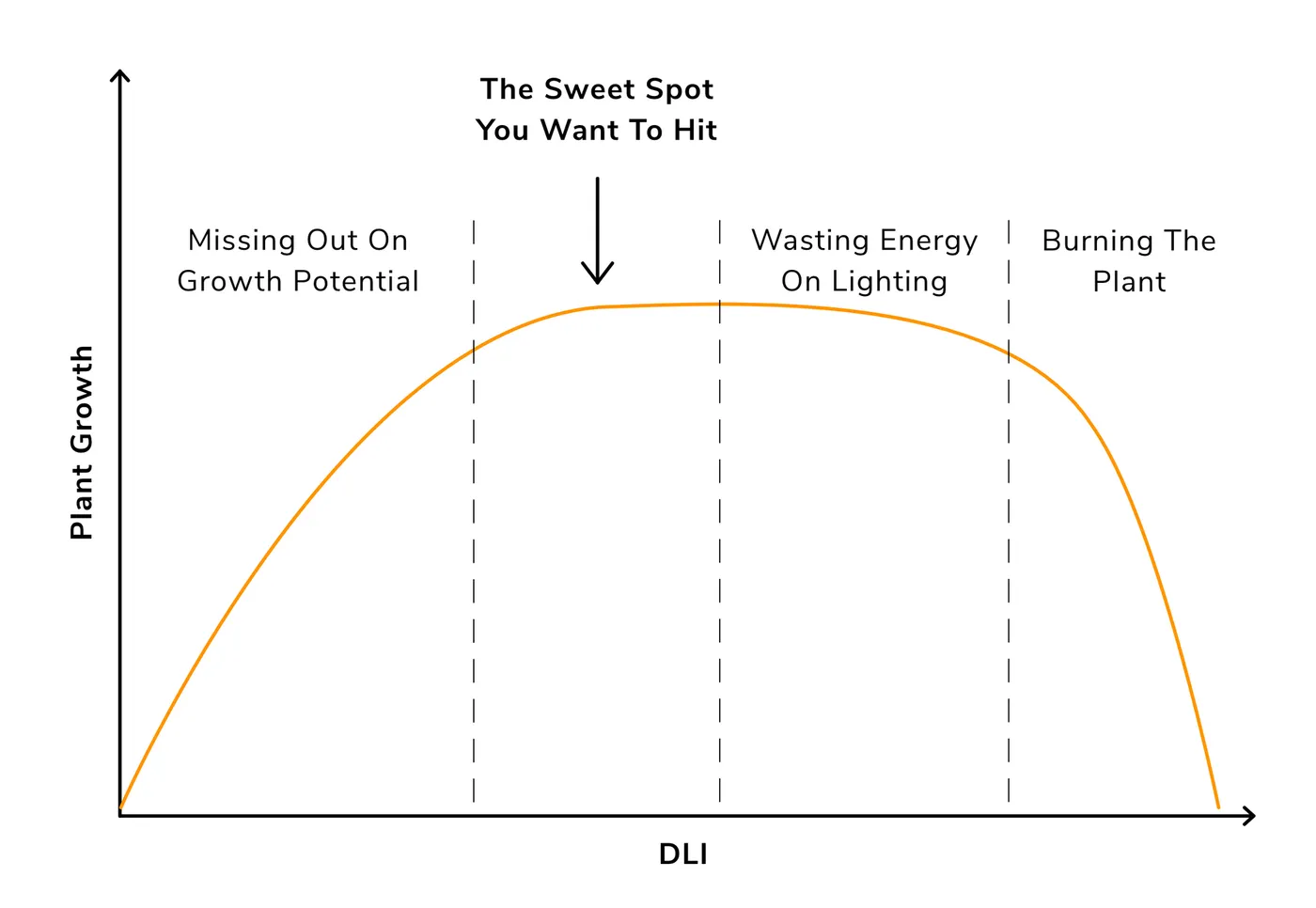
Below the optimum, plants stretch toward the light, produce thin stems and pale, widely spaced leaves, flower poorly, and yield little. Under-lighting is by far the most common problem in home grows, and it's usually invisible until harvest, because a plant getting half the light it wants still looks perfectly alive.
At the optimum, every additional photon still translates into growth. This is where you want to be.
Above saturation, the photosynthetic machinery is already running flat out. Extra photons don't get used — they get dissipated as heat, and eventually cause photoinhibition, bleached leaf tips, and stalled growth. You pay for the electricity, you pay for the cooling, and you get less plant.
What Sets the Ceiling
The saturation point isn't fixed. It moves depending on everything else in the room:
- CO₂ is usually the binding constraint. At ambient levels (~420 ppm), most C₃ crops saturate well before the light does. Enrichment to 1000–1200 ppm can lift the usable DLI substantially — which is why commercial cannabis figures look unreachable in a hobby tent.
- Temperature and VPD must keep pace. A plant that can't transpire can't use the light it's given.
- Water and nutrients have to support the growth rate the light is driving.
The upshot: published DLI maxima assume everything else is dialed in. If your CO₂, climate, and feed are ordinary, chasing the top of the range will cost you money and stress your plants. Work up gradually and watch how they respond.
DLI Requirements for Common Plants
| Plant | DLI (mol/m²/d) |
|---|---|
| Shade Plants | 6 - 10 |
| Peas | 9 - 12 |
| Basil | 12 - 26 |
| Broccoli | 15 - 35 |
| Tomatoes | 22 - 30 |
| Zucchini | 22 - 28 |
| Peppers | 20 - 30 |
| Cannabis | 12 - 45 |
Cannabis sits at the demanding end, which is why it needs serious fixtures — but the number changes dramatically across the grow. Seedlings want something in the mid-teens; late flower under CO₂ can justify 40 and up. We break the whole cycle down in Lighting Requirements of Cannabis Over the Full Grow Cycle.
For anything not on this list, search our plant light database.
Photoperiod Isn't Just a Multiplier
DLI treats a photoperiod as a number of hours to multiply by. Your plants don't.
Many species read day length as a seasonal signal. Short-day plants like cannabis, chrysanthemums, and poinsettias initiate flowering only once the dark period is long enough. Long-day plants like spinach and many lettuces bolt when days get long. And a handful — tomatoes, peppers, some herbs — are day-neutral and simply respond to the total.
So you can't always trade intensity for hours freely. Once a cannabis plant is in flower on a 12/12 schedule, the only way to raise its DLI is to raise intensity, because extending the photoperiod would revert it to vegetative growth. In veg, by contrast, an 18-hour day lets you hit the same DLI with a gentler, more efficient lamp.
Get the photoperiod right for the plant's biology first. Then use intensity to hit your DLI target within it.
Measure DLI With the Phone in Your Pocket
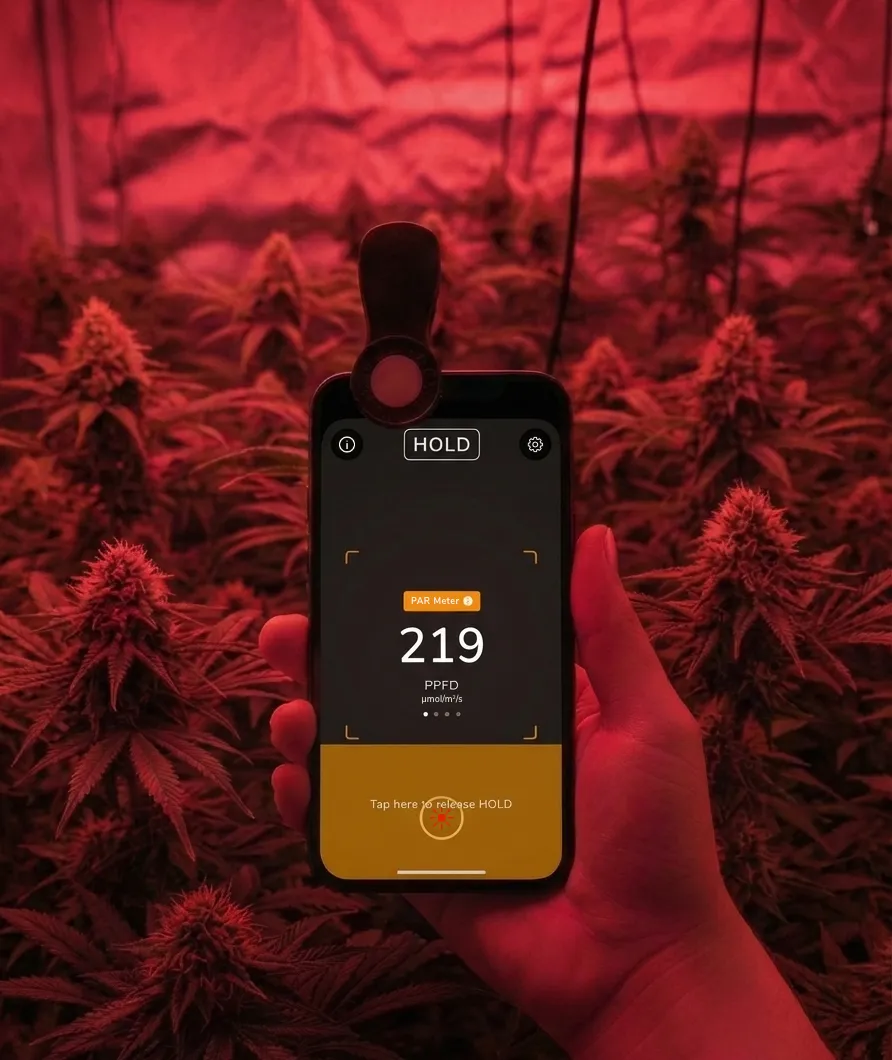
You don't need a dedicated instrument for any of this. Photone turns your phone or tablet into a PAR meter, using the front-facing camera as light sensor to measure PPFD accurately no matter if you grow under LED, HPS, CMH, MH or sunlight.
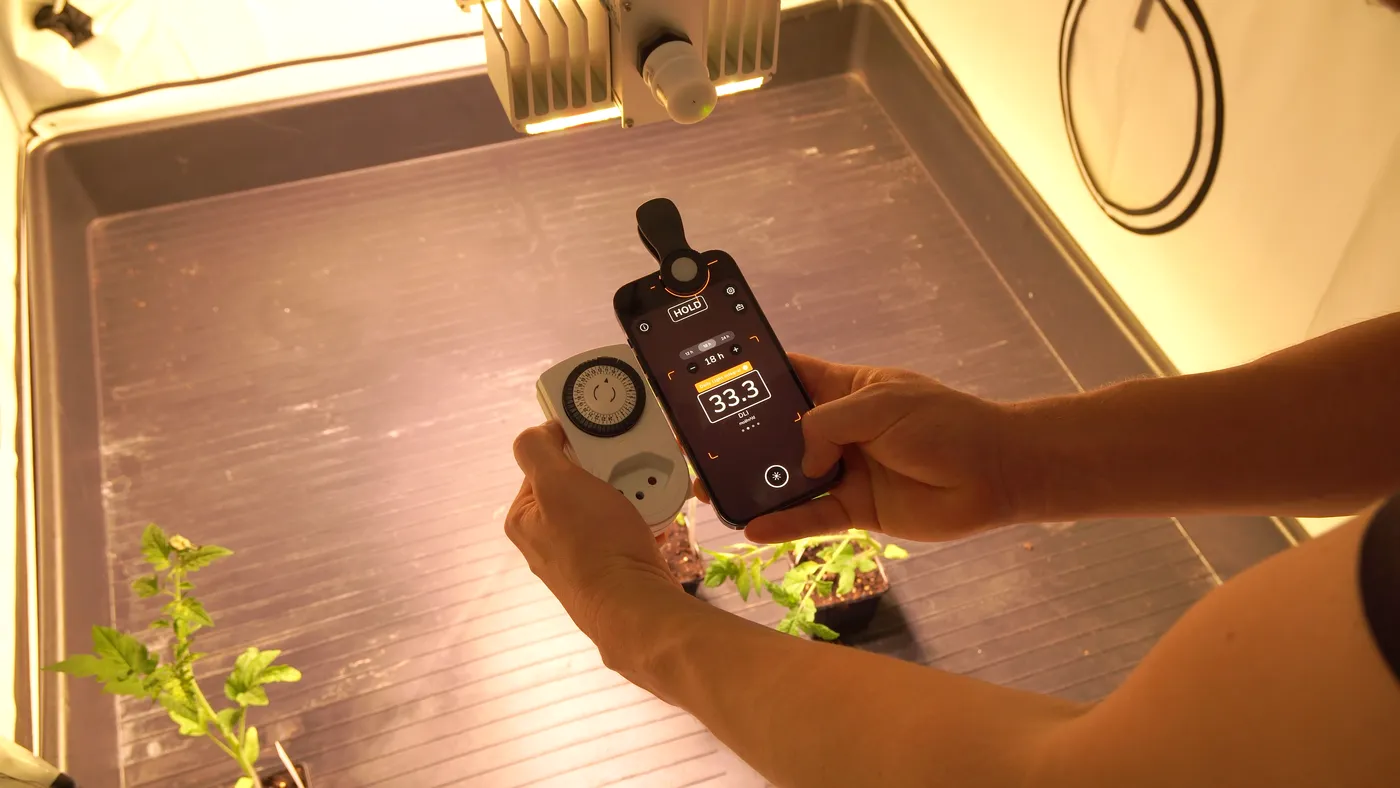
For artificial lighting, enter your photoperiod and Photone returns the projected DLI immediately — no waiting, no logging. For daylight or mixed setups, use the Logging tool and log PPFD across a full 24-hour period and give you the actual, integrated DLI, clouds and all.
Both methods, no extra hardware, and hundreds of dollars saved against a standalone meter. (If you're weighing one up anyway, we reviewed the options in Apogee's DLI Quantum Meters Reviewed)
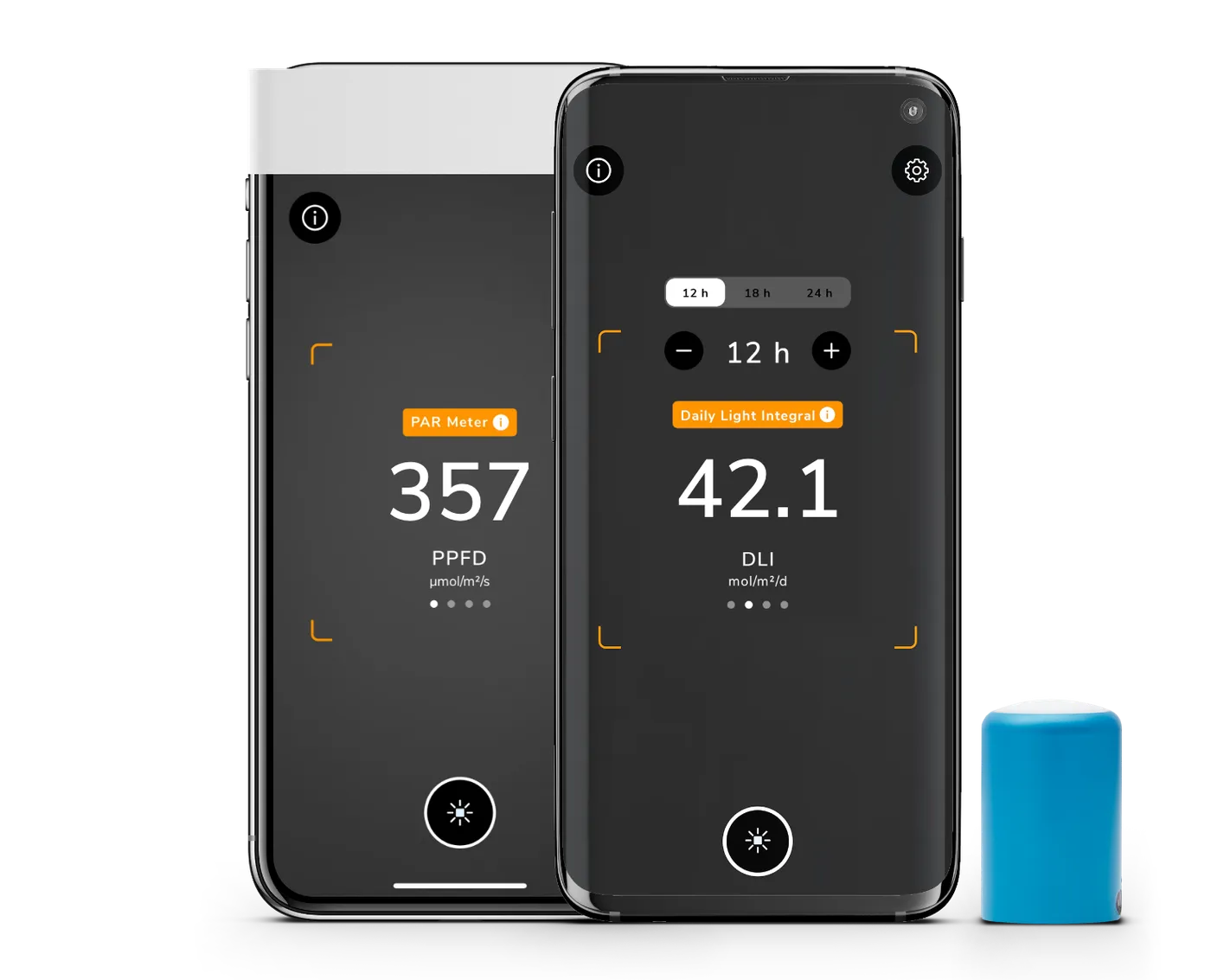
So: look up your crop's target, measure what you're actually delivering at canopy level, and close the gap. That one number will tell you more about your grow than any spec sheet ever will.
Frequently Asked Questions
What is a good DLI for most plants? Between 12 and 30 mol/m²/d covers the majority of edible crops. Houseplants and shade species are happy far lower, at 2–10, while high-light crops like cannabis and tomatoes sit at the top of the range or above.
How do I convert PPFD to DLI? Multiply PPFD by the number of hours the light is on, then by 0.0036. For example, 400 µmol/m²/s over 16 hours gives 23 mol/m²/d.
Can a plant get too much DLI? Yes. Past its saturation point, a plant can't use the extra photons and starts dissipating them as heat. Symptoms include bleached or yellowing upper leaves, curling tips, and growth that stalls despite more light.
Does DLI include moonlight or ambient room light? In practice, no. Both are orders of magnitude too dim to register meaningfully against a grow light or daylight.
Is DLI the same as PPFD? No. PPFD is the instantaneous rate of photon delivery; DLI is the daily total. Two setups with wildly different PPFD can produce an identical DLI.
What's the difference between PAR DLI and ePAR DLI? PAR counts photons from 400–700 nm; ePAR extends to 750 nm to include far-red. ePAR values run higher for the same light, so keep your measurement and your target in the same unit.