Auto-Translate
Grow lights are sold on numbers that most buyers never get to verify: watts, µmol/J, PPFD, PPF (learn what they mean). Independent teardowns and PAR tests keep showing that those numbers don't always match the hardware. Here's what's documented, and where marketing ends and deception begins.
The MIGRO Case: Advertised Components That Weren’t in the Light
MIGRO (or Migrolight) built its brand on transparency, PAR-testing competitors' lights for years and advertising "only the highest quality" Samsung and Osram LEDs in its own fixtures [1]. In August 2025, the YouTube channel Grand Master Level (GML) — affiliated with the competing brand Grand Master LEDs, which is worth keeping in mind — published a teardown of MIGRO's new 750 W ARAY [2][3]. It showed the fixture contained neither the advertised Samsung LM301H EVO diodes nor the advertised Osram reds — just weeks after MIGRO had confirmed on Instagram that it was still using Osram and Samsung [4].
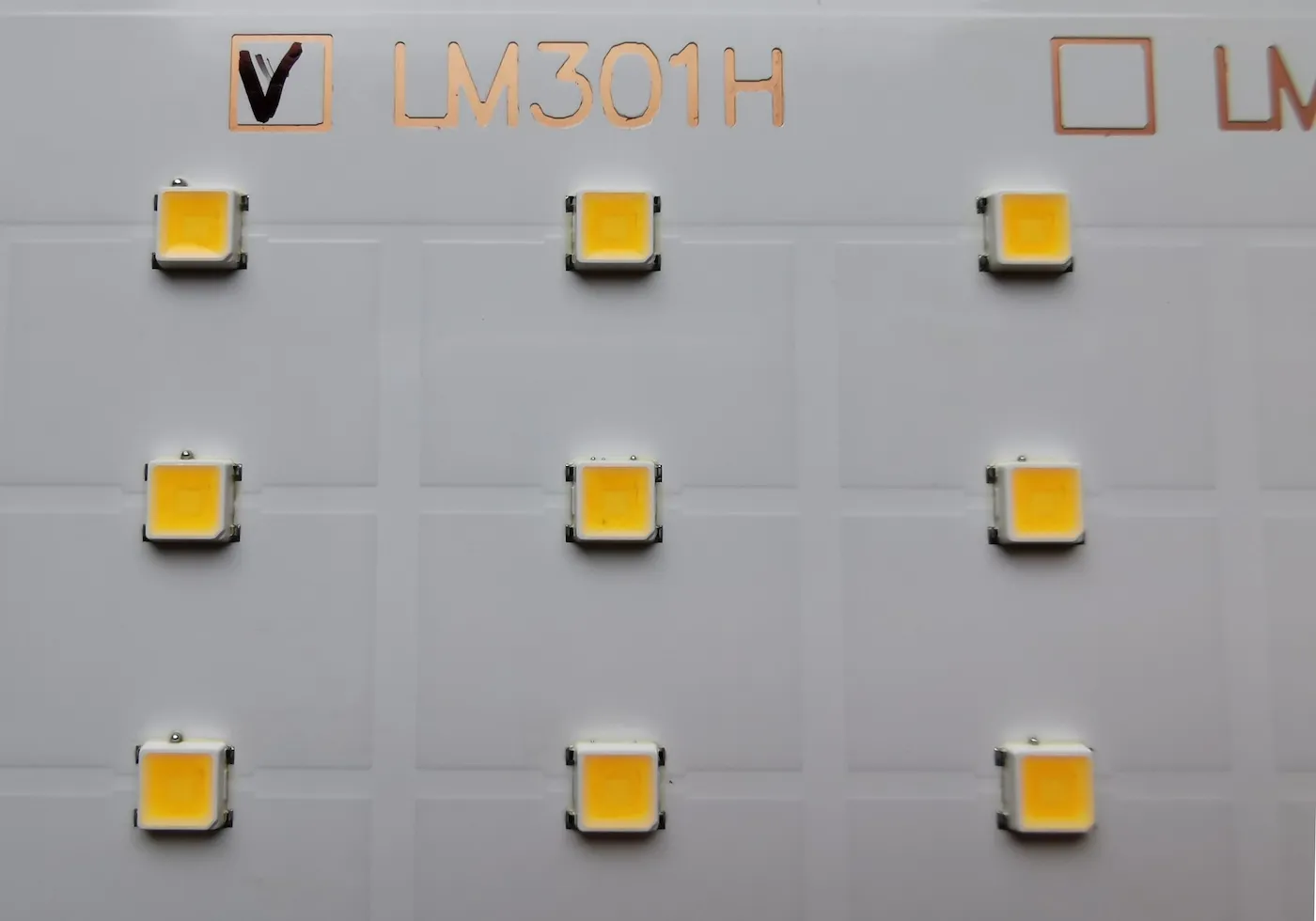
Shane Torpey responded with a video admitting the published specs were wrong, framing it as a mistake. That video has since been removed from YouTube, but its content is documented in contemporaneous forum discussion [4][5]. Notably, GML's lab's measurement still put the fixture at a solid ~2.9 µmol/J — the light wasn't bad, it just wasn't what the spec sheet said [4].
Months later, MIGRO closed permanently, citing insufficient funds to honor warranty claims [6]. What's proven: the shipped hardware didn't match the advertised components, the claim was repeated when customers asked directly, and the founder admitted the specs were wrong. What's not proven: intent, and whether the scandal caused the closure — the notice cites only finances. Either way, customers paid for components they didn't receive.

The Mars Hydro Case: Inflated Presentation, Not Proven Fabrication
Mars Hydro's published numbers have repeatedly come in above what independent testers measure. The most rigorous public test series (Coco for Cannabis using Apogee quantum sensors) rates the FC/FC-E fixtures as genuinely strong performers — yet measures usable canopy efficiency of 2.1–2.4 µmol/W [7], below the headline figures of up to 2.8 µmol/J in Mars Hydro marketing [8]. Part of that gap is physics (photons reaching a defined canopy area are always fewer than total fixture output), and part is the choice to lead with the most flattering number. Community testing has likewise found Mars Hydro fixtures around 10% below spec at operating temperature — with the caveat that "most light makers fudge their specs somewhat," since specs are often captured on a cold fixture before output drops with heat [4]. Individual growers have been disputing Mars Hydro's published PPFD maps with their own measurements since at least 2021 [9].
Two practices stand out, neither unique to Mars Hydro. Model naming: the TS 1000 draws 150 W [10] — actual wattage is in the spec sheet, but numbers that read like watts predictably mislead beginners. And measurement conditions: many manufacturers capture PPFD maps inside reflective tents, where mylar walls (reflecting up to ~85% of PAR photons) bounce light back onto the sensor and inflate readings versus an open room [11][12].
Patterns Across the Industry
- Fictional wattage. "1000W" lights drawing 100–250 W, justified by unverifiable "HPS equivalent" claims — concentrated on Amazon/eBay, and historically propped up by the debunked claim that plants "don't use" green light [13].
- Misrepresented or counterfeit diodes. Counterfeit "Samsung" diodes are common enough that manufacturers publish identification guides [14], and teardowns of budget fixtures find unbranded diodes behind brand-name retail claims [15].
- Flattering PPFD maps. Reflective-wall testing, sparse measurement grids that hide poor uniformity, and publishing only peak values [11].
Why does this happen? Buyers can't easily verify the numbers, marketplace rankings reward the biggest claims, price competition punishes honesty, and contract manufacturing means brands don't always check what's actually mounted on their boards — the most charitable reading of the MIGRO case.
What Can You as a Grower Do About It?
Ignore "equivalent wattage" and check actual power draw. Read PPFD maps with the test conditions in mind — tent or open room, hanging height, grid density. Prefer fixtures validated by independent tests with disclosed methodology.
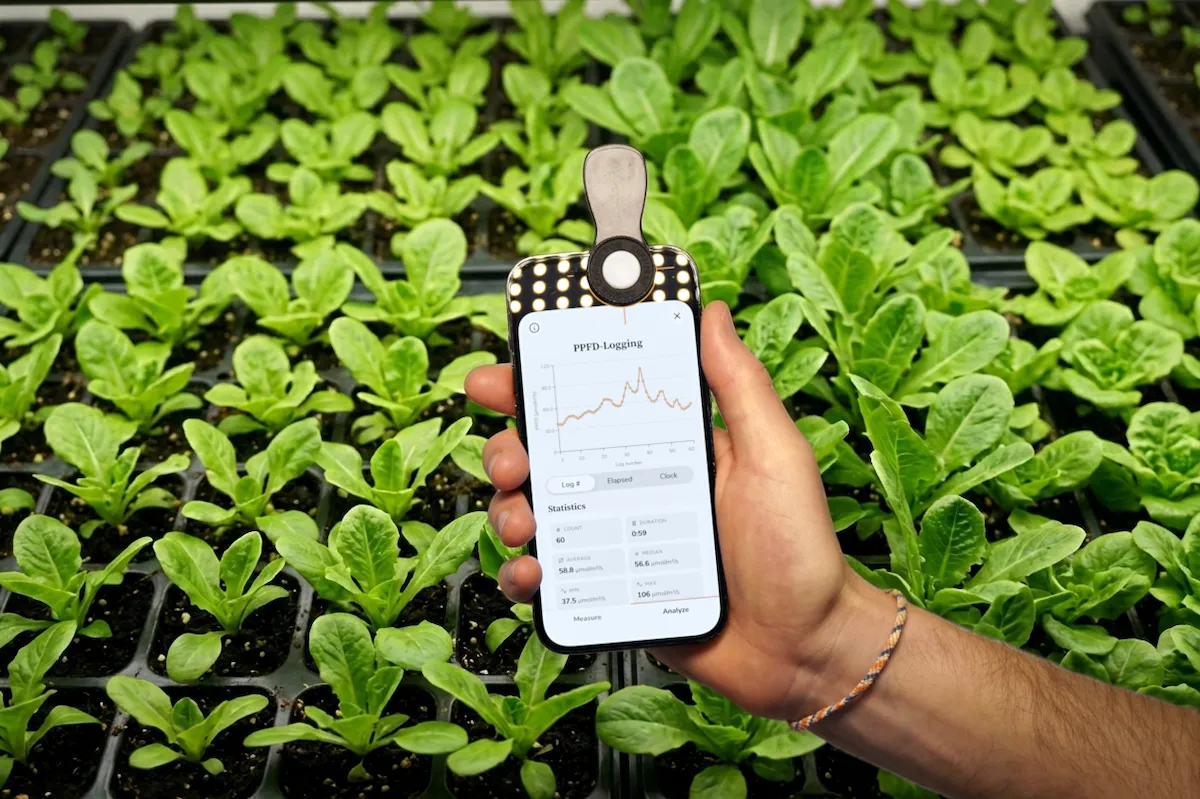
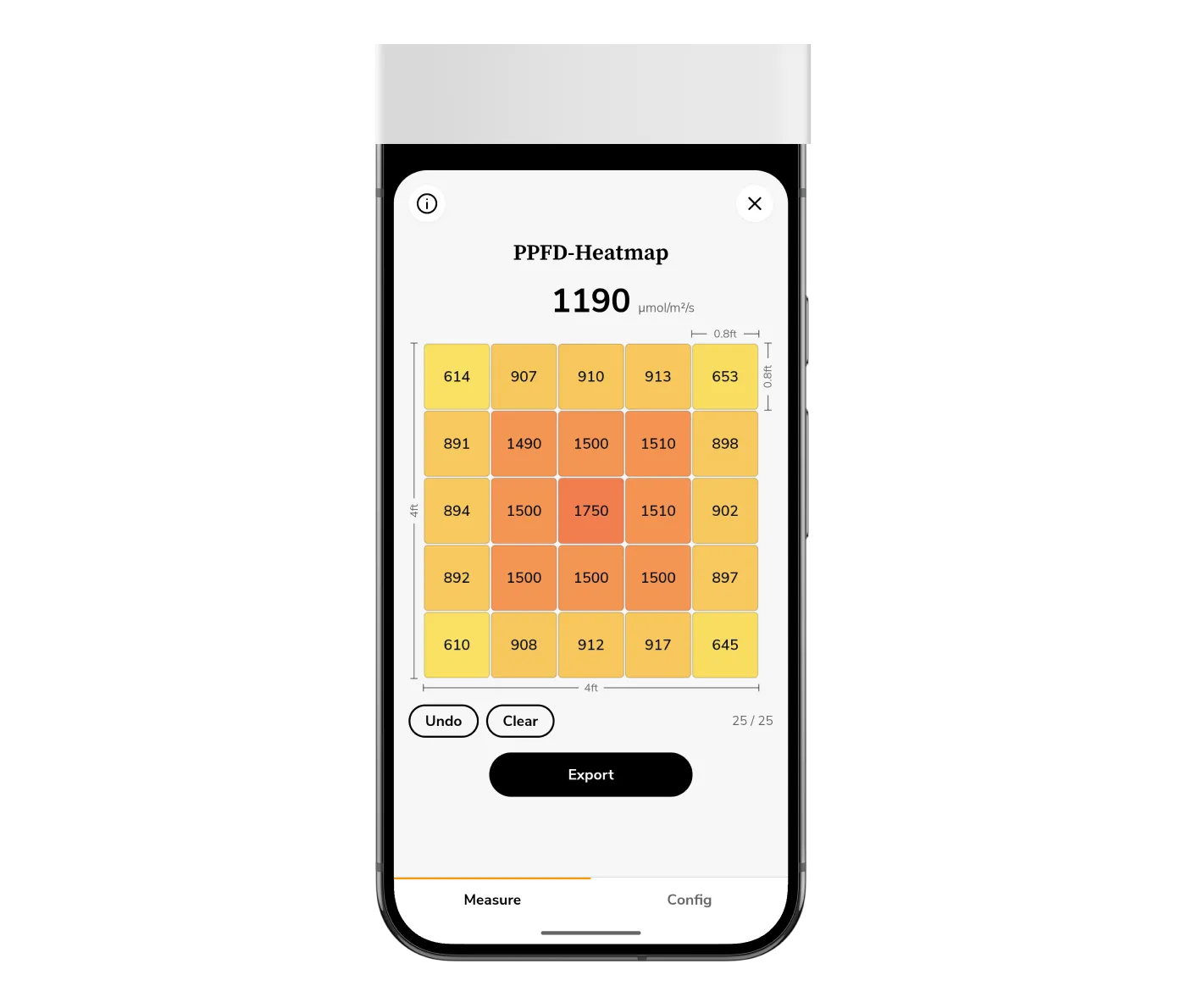
Most importantly: verify the light at your own canopy. With the free Photone – Grow Light Meter app, you can measure the PPFD your plants actually receive. Create your own heatmap of your grow area, and share it with other growers to compare against the manufacturer's maps. The gap between the brochure and your canopy is exactly where this whole problem lives — and as the MIGRO episode showed, even the most trusted name isn't a substitute for measuring it yourself.
References
[1]
MIGRO, product page: "We use Meanwell LED drivers & Samsung and Osram LEDs which are of the highest quality."
https://migrolight.com/collections/plant-grow-light (Website was taken offline in June 2026)
[2]
Grand Master Level, teardown of the new MIGRO ARAY (YouTube, Aug 2025). The physical evidence of the diode discrepancy. GML is affiliated with competing brand Grand Master LEDs.
https://www.youtube.com/watch?v=vO2OASrwzOo
[3]
JustInTimeGrow, repost of [2] with written permission (YouTube, Aug 2025) — backup link.
https://www.youtube.com/watch?v=9cQGUpipse8
[4]
Rollitup forum thread, Aug 2025: first-hand account from the customer who raised the diode question, screenshots of MIGRO's July 11 Samsung/Osram statements, description of the (since-removed) admission video, GML's ~2.9 µmol/J measurement, and community testing of Mars Hydro at ~10% below spec at operating temperature.
https://www.rollitup.org/t/migros-light-disected-incredible-video.1106880/
[5]
Shane Torpey / MIGRO, response video admitting incorrect specs (YouTube, Aug 2025).
https://www.youtube.com/watch?v=QW3NhME8LE8 (Video was removed from YouTube in June 2026. Content documented in [4].)
[6]
MIGRO, official closure notice.
https://migrolight.com/
[7]
Coco for Cannabis, Mars Hydro FC-E3000 PAR test: 2.17 µmol/W measured usable efficiency.
https://www.cocoforcannabis.com/grow-light-guide/mars-hydro-fc-e3000-par-epar-test-and-review/
[8]
Mars Hydro SP3000 retail listing: "2.8 µmol/j efficacy."
https://www.walmart.com/ip/Mars-Hydro-SP3000-LED-Grow-Light-Kit-108cm-300W-Full-Spectrum-Indoor-Black/1847243416
[9]
"Mars Hydro PPFD Map (What is going on with MarsHydro??)" (YouTube, Feb 2021): a grower's measurements contradicting the FC6500 map then on Mars Hydro's website. Small channel, single tester.
https://www.youtube.com/watch?v=M1oXTCFUtf4
[10]
Mars Hydro, official TS 1000 page: "Wattage 150W±5%."
https://www.mars-hydro.com/ts-1000-led-grow-light
[11]
Treegers, "PPFD Readings & Maps: How to Analyze Them Accurately and Avoid Misleading Data" (2025). Written by a competing manufacturer.
https://eu.treegers.com/blogs/technology-science-articles/ppfd-readings-maps-how-to-analyze-them-accurately-and-avoid-misleading-data
[12]
Coco for Cannabis, testing protocol: mylar walls reflect up to 85% of PAR photons.
https://www.cocoforcannabis.com/grow-light-testing-protocol/
[13]
AlboPepper, "Entry Level LED Grow Lights: Disappointments Due to False Wattage Claims & Poor Life Span."
https://albopepper.com/LED-grow-light-disappointment.php
[14]
Spider Farmer, "How to Tell Real Samsung LM301B Diodes from Fake."
https://www.spider-farmer.com/how-to-distinguish-real-samsung-led-grow-light/
[15]
AlboPepper, Mars Hydro TS1000 instrumented review: diodes found unbranded.
https://albopepper.com/reviews-garden-products-mars-hydro-TS1000-LED-grow-light-review.php